Description
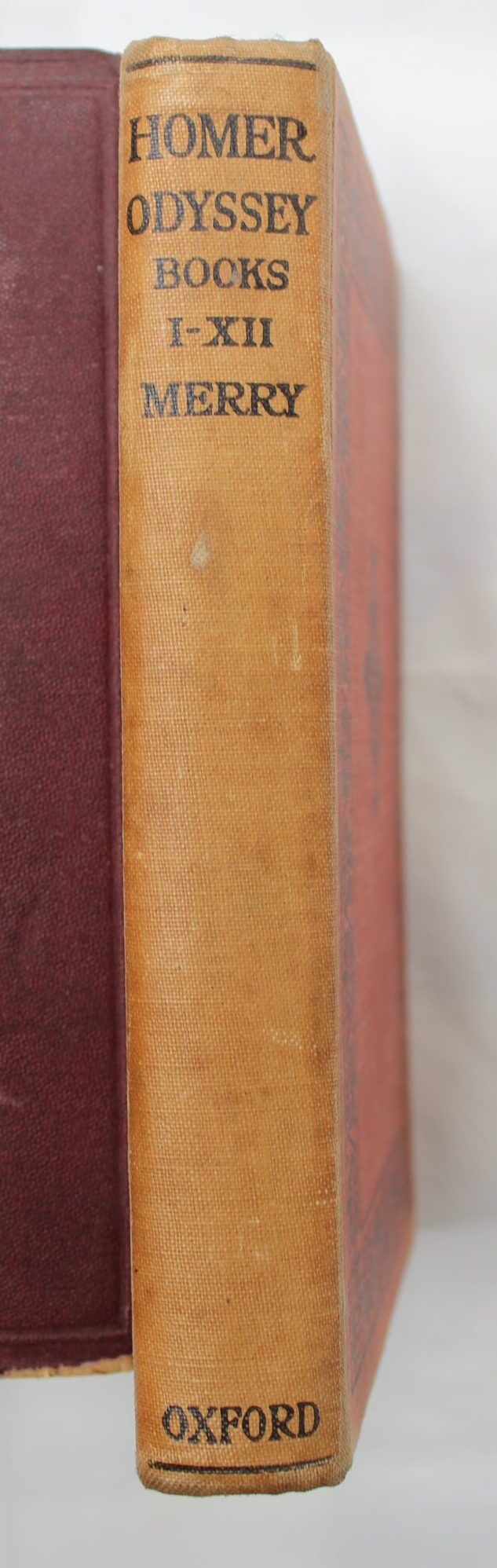
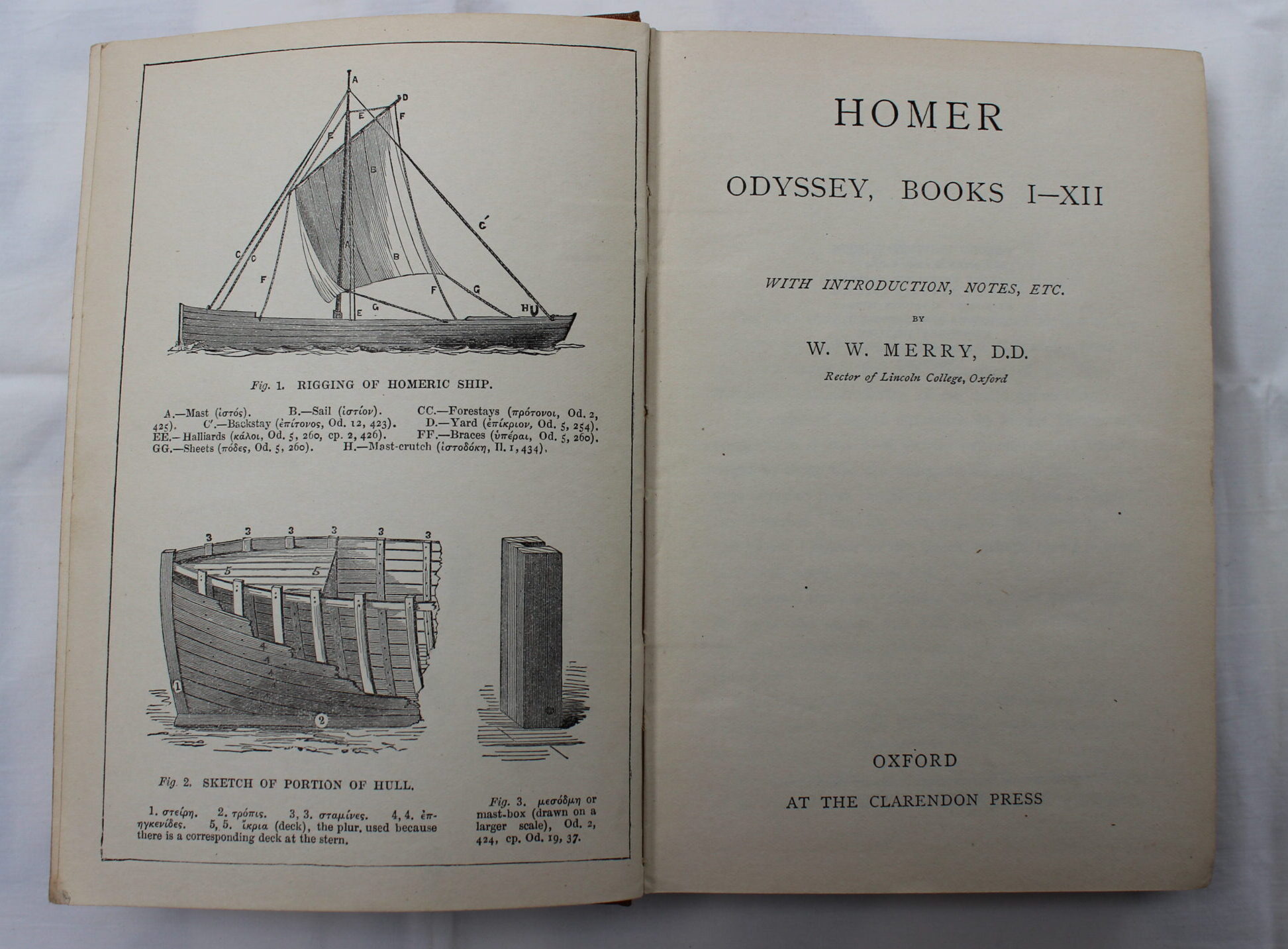
Homers Odyssey is a poem is divided into 24 books. It follows the Greek hero Odysseus, king of Ithaca, and his journey home after the Trojan War.
This volume covers books 1 to 12.
Exposition (books 1–4)
The Odyssey begins after the end of the ten-year Trojan War (the subject of the Iliad), from which Odysseus (also known by the Latin variant Ulysses), king of Ithaca, has still not returned because he angered Poseidon, the god of the sea. Odysseus’ son, Telemachus, is about 20 years old and is sharing his absent father’s house on the island of Ithaca with his mother Penelope and the suitors of Penelope, a crowd of 108 boisterous young men who each aim to persuade Penelope for her hand in marriage, all the while reveling in the king’s palace and eating up his wealth.
Odysseus’ protectress, the goddess Athena, asks Zeus, king of the gods, to finally allow Odysseus to return home when Poseidon is absent from Mount Olympus. Disguised as a chieftain named Mentes, Athena visits Telemachus to urge him to search for news of his father. He offers her hospitality, and they observe the suitors dining rowdily while Phemius, the bard, performs a narrative poem for them.
That night, Athena, disguised as Telemachus, finds a ship and crew for the true prince. The next morning, Telemachus calls an assembly of citizens of Ithaca to discuss what should be done with the insolent suitors, who then scoff at Telemachus. Accompanied by Athena (now disguised as Mentor), the son of Odysseus departs for the Greek mainland to the household of Nestor, most venerable of the Greek warriors at Troy, who resided in Pylos after the war.
From there, Telemachus rides to Sparta, accompanied by Nestor’s son. There he finds Menelaus and Helen, who are now reconciled. Both Helen and Menelaus also say that they returned to Sparta after a long voyage by way of Egypt. There, on the island of Pharos, Menelaus encounters the old sea-god Proteus, who tells him that Odysseus was a captive of the nymph Calypso. Telemachus learns the fate of Menelaus’ brother, Agamemnon, king of Mycenae and leader of the Greeks at Troy: he was murdered on his return home by his wife Clytemnestra and her lover Aegisthus. The story briefly shifts to the suitors, who have only just realized that Telemachus is gone. Angry, they formulate a plan to ambush his ship and kill him as he sails back home. Penelope overhears their plot and worries for her son’s safety.
Escape to the Phaeacians (books 5–8)
In the course of Odysseus’ seven years as a captive of Calypso on the island Ogygia, she has fallen deeply in love with him, even though he spurns her offers of immortality as her husband and still mourns for home. She is ordered to release him by the messenger god Hermes, who has been sent by Zeus in response to Athena’s plea. Odysseus builds a raft and is given clothing, food, and drink by Calypso. When Poseidon learns that Odysseus has escaped, he wrecks the raft, but helped by a veil given by the sea nymph Ino, Odysseus swims ashore on Scherie, the island of the Phaeacians. Naked and exhausted, he hides in a pile of leaves and falls asleep.
The next morning, awakened by girls’ laughter, he sees the young Nausicaä, who has gone to the seashore with her maids after Athena told her in a dream to do so. He appeals for help. She encourages him to seek the hospitality of her parents, Arete and Alcinous. Alcinous promises to provide him a ship to return him home without knowing the identity of Odysseus. He remains for several days. Odysseus asks the blind singer Demodocus to tell the story of the Trojan Horse, a stratagem in which Odysseus had played a leading role. Unable to hide his emotion as he relives this episode, Odysseus at last reveals his identity. He then tells the story of his return from Troy.
Odysseus’ account of his adventures (books 9–12)
Odysseus recounts his story to the Phaeacians. After a failed raid against the Cicones, Odysseus and his twelve ships were driven off course by storms. Odysseus visited the lotus-eaters who gave his men their fruit which caused them to forget their homecoming. Odysseus had to drag them back to the ship by force.
Afterward, Odysseus and his men landed on a lush, uninhabited island near the land of the Cyclopes. The men entered the cave of Polyphemus, where they found all the cheeses and meat they desired. Upon returning to his cave, Polyphemus sealed the entrance with a massive boulder and proceeded to eat Odysseus’ men. Odysseus devised an escape plan in which he, identifying himself as “Nobody,” plied Polyphemus with wine and blinded him with a wooden stake. When Polyphemus cried out, his neighbors left after Polyphemus claimed that “Nobody” had attacked him. Odysseus and his men finally escaped the cave by hiding on the underbellies of the sheep as they were let out of the cave.
As they escaped, however, Odysseus taunted Polyphemus and revealed himself. The Cyclops prayed to his father Poseidon, asking him to curse Odysseus to wander for ten years. After the escape, Aeolus gave Odysseus a leather bag containing all the winds except the west wind, a gift that should have ensured a safe return home. Just as Ithaca came into sight, the sailors opened the bag while Odysseus slept, thinking it contained gold. The winds flew out, and the storm drove the ships back the way they had come. Aeolus, recognizing that Odysseus had drawn the ire of the gods, refused to further assist him.
After the cannibalistic Laestrygonians destroyed all of his ships except his own, Odysseus sailed on and reached the island of Aeaea, home of witch-goddess Circe. She turned half of his men into swine with drugged cheese and wine. Hermes warned Odysseus about Circe and gave Odysseus an herb called moly, making him resistant to Circe’s magic. Odysseus forced Circe to change his men back to their human forms and was seduced by her. They remained with her for one year. Finally, guided by Circe’s instructions, Odysseus and his crew crossed the ocean and reached a harbor at the western edge of the world, where Odysseus sacrificed to the dead. Odysseus summoned the spirit of the prophet Tiresias and was told that he may return home if he is able to stay himself and his crew from eating the sacred livestock of Helios on the island of Thrinacia and that failure to do so would result in the loss of his ship and his entire crew. He then meets his dead mother Anticleia and first learns of the suitors and what happened in Ithaca in his absence. Odysseus also converses with his dead comrades from Troy.
Returning to Aeaea, they buried Elpenor and were advised by Circe on the remaining stages of the journey. They skirted the land of the Sirens. All of the sailors had their ears plugged up with beeswax, except for Odysseus, who was tied to the mast as he wanted to hear the song. He told his sailors not to untie him as it would only make him drown himself. They then passed between the six-headed monster Scylla and the whirlpool Charybdis. Scylla claimed six of his men.
Next, they landed on the island of Thrinacia, with the crew overriding Odysseus’s wishes to remain away from the island. Zeus caused a storm that prevented them from leaving, causing them to deplete the food given to them by Circe. While Odysseus was away praying, his men ignored the warnings of Tiresias and Circe and hunted the sacred cattle. Helios insisted that Zeus punish the men for this sacrilege. They suffered a shipwreck, and all but Odysseus drowned as he clung to a fig tree. Washed ashore on Ogygia, he remained there as Calypso’s lover.
Second Edition. 141 pages.